


The short answer
AI investment becomes a competitive decision when leaders connect it to a customer expectation the business may struggle to meet. Start by identifying that exposure, test whether AI can address it and agree what evidence would justify moving faster.
Three decisions to take away
- Identify the customer expectation at risk.
- Test the assumption before increasing spend.
- Agree what evidence will change the pace.
What the research found
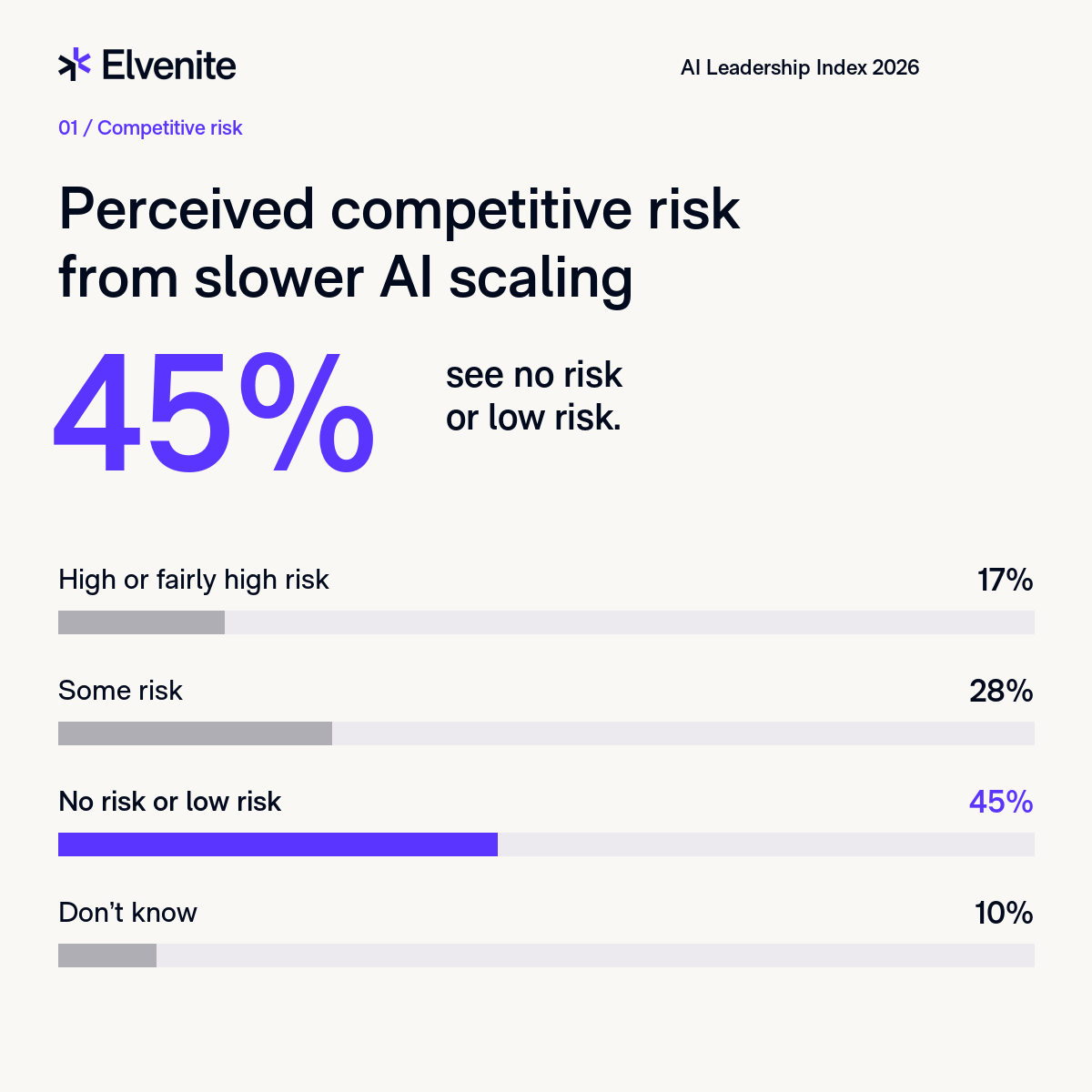
33% report increased AI investment over the previous 12 months; 45% see low or no risk of losing competitiveness if AI is not scaled faster.
AI Leadership Index 2026 · Prime/Norstat · 163 respondents in Sweden · March–April 2026. Indicative; not statistically representative of Swedish business.
These findings do not establish which companies are falling behind or prove that spending more creates an advantage. Leaders need to examine their own market before drawing that conclusion.
Where could changing customer expectations put you at risk?
Begin with a reason customers choose your business. That could be specialist advice, a clear product recommendation or the ability to adapt an offer to a particular requirement. Ask where a change in customer expectations would put that reason under pressure.
Hypothetical example
Consider a manufacturer whose buyers start expecting a documented product recommendation during the first technical enquiry. Its specialists currently need several days to assemble the answer. A competitor advertises AI-supported recommendations.
A competitor’s announcement is a signal to investigate, not proof that its advice is accurate or that customers prefer it. Use recent enquiries, lost-business reasons and commercial-team feedback to check whether buyers’ expectations are changing.
What should you test before investing more?
Choose the uncertainty that most affects the investment decision. Customer interviews can examine whether a quicker recommendation matters to buyers. A comparison using past technical enquiries can test the accuracy, completeness and preparation effort of an AI-supported draft against the current approach.
Include the cost of preparing product information and the specialist time needed to check answers. A convincing demonstration alone cannot establish commercial usefulness or the cost of maintaining the capability.
When should you accelerate, adapt or wait?
Set explicit reasons for accelerating, adapting or waiting. Suggested criteria include repeated buyer requests, verified evidence of a competing capability, or useful recommendations at an acceptable total cost. These are editorial recommendations, not outcomes established by the survey.
Also agree what would weaken the case, such as extensive correction work or a preference for direct specialist contact. If the decision is to wait, specify the market signal that would reopen it and when to check again.
Elvenite editorial recommendation
Bring an exposure assessment to the next investment discussion
Using the hypothetical manufacturer above, a completed assessment could read:
- Customer expectation: A documented product recommendation during the first technical enquiry.
- Current ability: Specialists need several days to prepare it.
- Evidence of a possible gap: A competitor advertises AI-supported recommendations; buyer expectations remain unverified.
- Untested assumption: AI can help prepare accurate recommendations with less specialist effort.
- Signal to change investment pace: Buyers confirm the need, and a test using past enquiries produces reliable recommendations at an acceptable total cost.
Use the same five fields for your business. Record “unknown” where evidence is missing. These are suggested criteria, not survey findings.
About the research
The AI Leadership Index 2026 survey was conducted by Prime for Elvenite through Norstat’s panel in March–April 2026. The 163 respondents in Sweden held responsibility for or strong insight into their organisation’s AI and digitalisation work. Findings are indicative and not statistically representative of Swedish business. The recommendations above are Elvenite’s editorial interpretation.
Read the competitive risk gap in the report and take the assessment into your next investment discussion.


About the author
Elvenite
Elvenite is the Nordic market leader in Infor CloudSuite M3, data and AI. Our specialists share practical knowledge about ERP, Data Intelligence, AI and the long-term development of business-critical systems.
Learn more about Elvenite / Explore more articles from Elvenite
Related news
Swedish companies score only 39 out of 100 in new AI Leadership Index

Blentagruppen selects Elvenite for Infor CloudSuite Food & Beverage

Infor October 2026 release: what changed and what M3 customers should review
Explore the six AI leadership gaps