


The short answer
AI integration means connecting AI-supported work to the information, systems and approvals needed to complete a business process. Start with one workflow. Map what AI prepares, who approves the action and how the team confirms it is complete, including when a handover fails.
Three decisions to take away
- Choose one workflow and define what should improve.
- Decide what AI prepares and who approves the action.
- Test completion and recovery before expanding.
What the research found
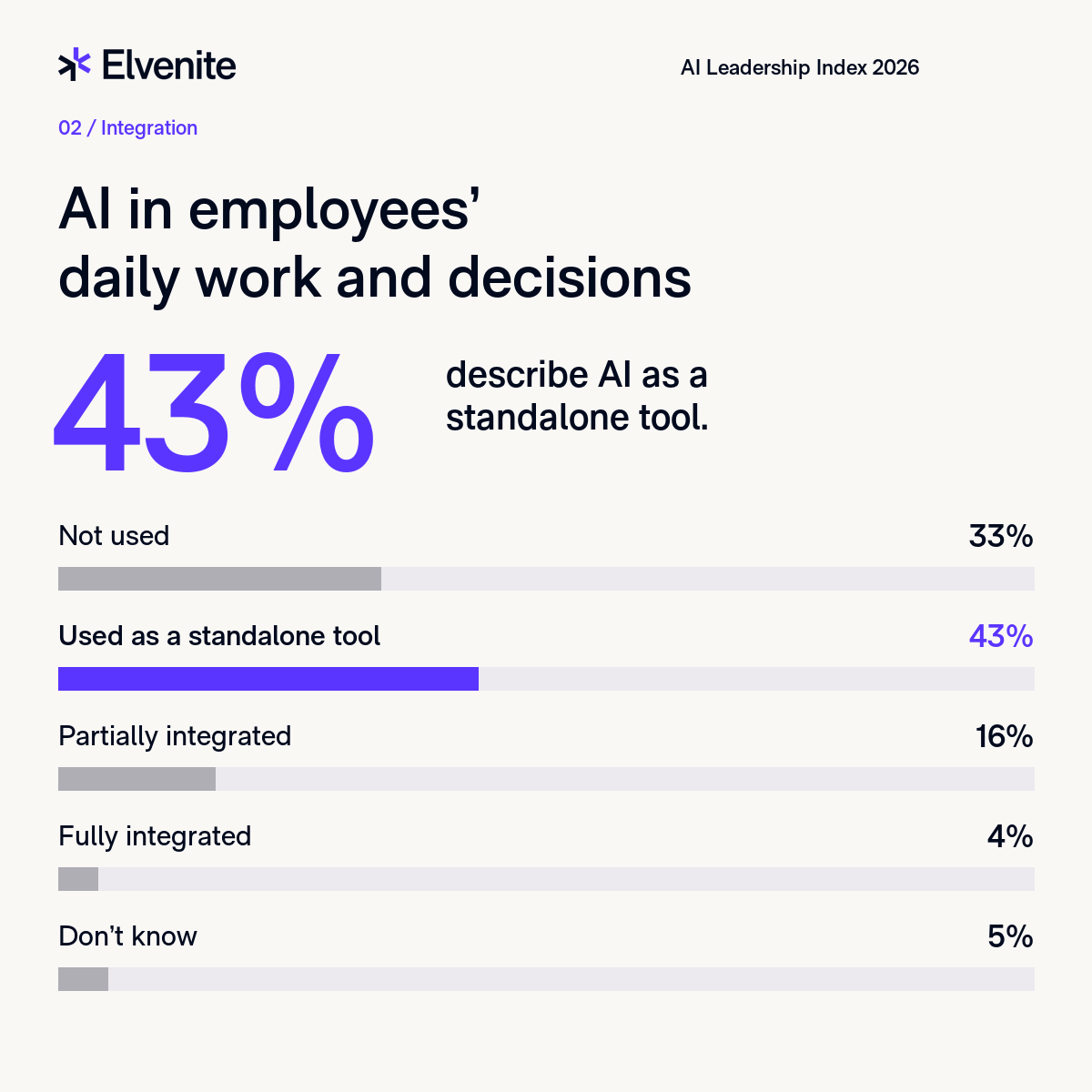
43% describe AI as a standalone tool in employees’ tasks and decisions; 4% describe it as fully integrated. In a separate question, 54% report no AI in business-critical production.
AI Leadership Index 2026 · Prime/Norstat · 163 respondents in Sweden · March–April 2026. Indicative; not statistically representative of Swedish business.
These are self-reported descriptions of AI use. Results from the two questions should not be combined and do not establish which workflow changes improve performance. The method below is Elvenite’s editorial guidance.
Which workflow should you improve first?
Choose a recurring workflow with a known delay or a difficult handover. Name its owner and map the current work before choosing the AI capability. Include finding documents, checking information, asking colleagues and correcting missing data.
Hypothetical example
A supplier reports a delay. A planner needs the ERP order, inventory, supplier message and production priorities before recommending a response. Summarising the message alone leaves most of that preparation untouched.
Map the chain with the people who perform and receive the work. Agree what should improve: for example, a planner receives a complete brief sooner, with affected orders, current stock and the supplier’s latest delivery information clearly sourced.
Which actions need a person’s approval?
Decide what AI may prepare and who can approve the resulting action. For a first version of the supply workflow, AI could assemble the exception brief. The planner checks the options; an authorised buyer approves any order change. Agree separately who may confirm a delivery commitment.
Make missing or outdated information visible. If the supplier’s delivery date is unclear or stock records conflict, flag the brief for review before anyone acts on it.
These approval boundaries also matter in ERX, or Enterprise Resource Execution, an emerging direction towards governed action across ERP and connected systems. A workflow map makes the discussion specific: what may change, who approves it and how completion is confirmed.
How will you know the handover is complete?
Confirm that the approved action is recorded in the business system. Walk through a normal case and a failed ERP update with the people involved. Keep the exception open until the saved change is confirmed, with its approval record attached.
Compare the current and proposed workflow using similar cases. Count preparation, checking, waiting for approval and correction time through to completion. Expand only when the agreed improvement holds without losing required checks or leaving actions unresolved. Name contacts for process, data and technical failures before normal operation.
Elvenite editorial recommendation
Leave with a map of one complete workflow
For the hypothetical supply exception, a six-field map could read:
- Trigger: A supplier reports a delay affecting an open order.
- Sources: ERP order, inventory, supplier message and production priorities.
- AI contribution: Assemble an exception brief with source references and flag missing information.
- Human decision: The planner reviews options; the authorised buyer approves any order change.
- Business action: The buyer records the approved change in ERP; the planner checks the saved order and closes the exception.
- Failure path: Without confirmation of the saved change, the exception stays open for the planner. Check the ERP record before retrying or completing the update manually.
Use these six fields for your workflow. Agree how an open exception reaches its owner and how the approval record is retained during recovery. Resolve any blank action or failure field before extending the workflow. This is a hypothetical design, not a customer result.
About the research
The AI Leadership Index 2026 survey was conducted by Prime for Elvenite through Norstat’s panel in March–April 2026. The 163 respondents in Sweden held responsibility for or strong insight into their organisation’s AI and digitalisation work. Findings are indicative and not statistically representative of Swedish business. The recommendations above are Elvenite’s editorial interpretation.
Read the integration findings in the report to put your workflow discussion in context.


About the author
Elvenite
Elvenite is the Nordic market leader in Infor CloudSuite M3, data and AI. Our specialists share practical knowledge about ERP, Data Intelligence, AI and the long-term development of business-critical systems.
Learn more about Elvenite / Explore more articles from Elvenite
Related news

Swedish companies score only 39 out of 100 in new AI Leadership Index

Blentagruppen selects Elvenite for Infor CloudSuite Food & Beverage
Explore the six AI leadership gaps