


The short answer
Measuring AI business value means comparing a business outcome with a credible baseline and accounting for the full cost of achieving it. Before the pilot, agree what should improve, how you will measure it and what evidence would justify further investment. Count checking and corrections alongside time saved.
Three decisions to take away
- Define the outcome and measure the complete task.
- Count full costs and distinguish capacity from cash savings.
- Agree the evidence needed to expand, revise or stop.
What the research found
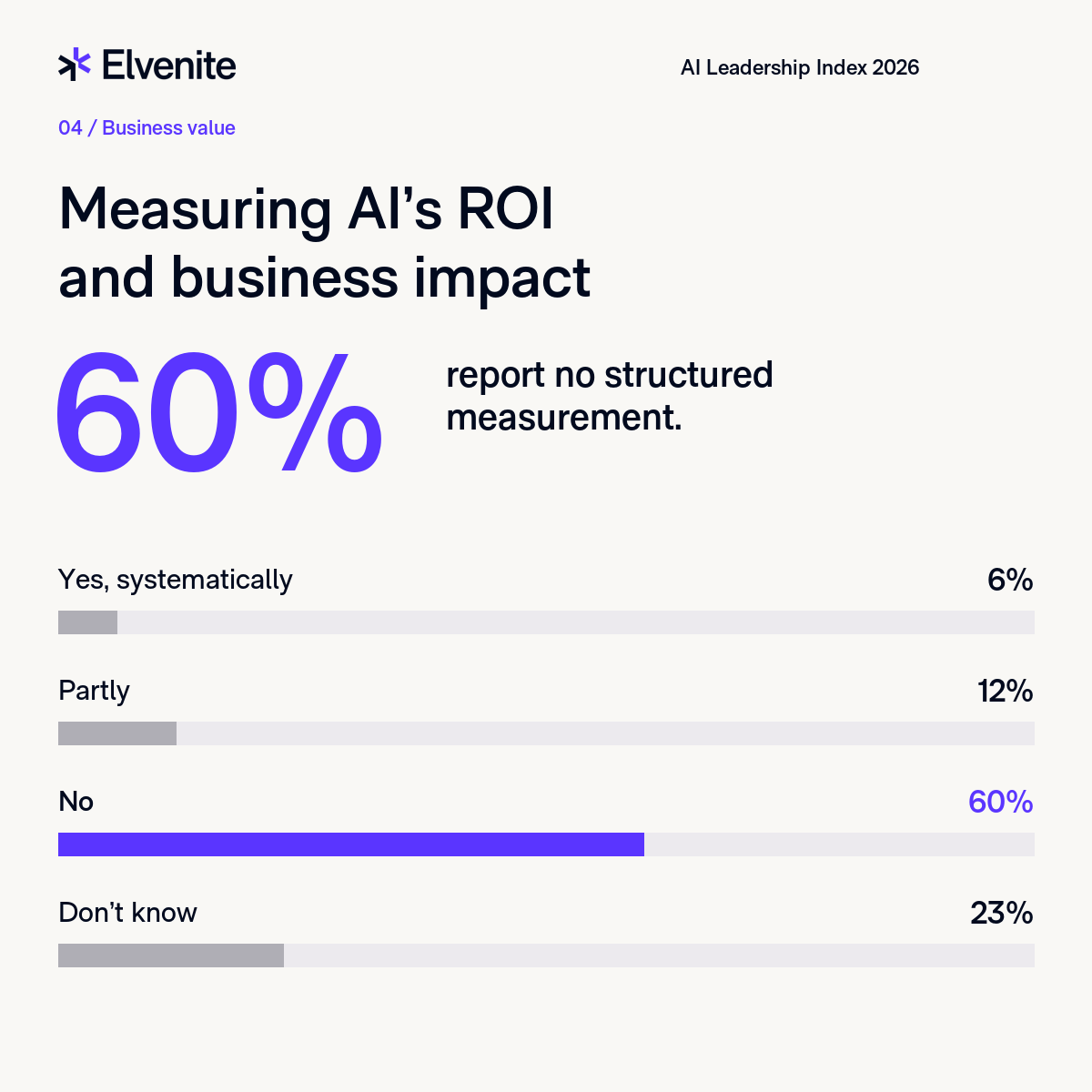
In Elvenite’s AI Leadership Index 2026, 60% report no structured measurement of ROI or other business effects from AI initiatives; 6% report systematic measurement. In separate questions, 31% identify productivity as a positive effect, while 60% report clear objectives or KPIs to a low extent or not at all.
Prime for Elvenite, through Norstat’s panel · 163 respondents in Sweden · March–April 2026. Indicative; not statistically representative of Swedish business.
These are self-reported findings. They distinguish perceived benefit from structured follow-up; they do not establish the return an individual company can expect. The three decisions below are Elvenite’s editorial recommendations.
What should you measure before an AI pilot starts?
Choose one business outcome and record a comparable baseline for the complete task. For an invoice-processing pilot, measure human effort from receiving an invoice to approving it for payment. Include preparation, checking and corrections, with quality tracked alongside time.
Hypothetical invoice-pilot example
Assume a team processes 1,000 comparable invoices per month. Current handling takes eight minutes per invoice. With AI support, preparation takes three minutes, checking takes two and corrections add one minute on average across all invoices.
The five-minute reduction in preparation becomes a two-minute reduction in total human effort: eight minutes minus six. Across 1,000 invoices, that releases about 33 hours per month, before ongoing support and maintenance.
Record the period, supplier mix and complexity behind both measurements. Track incorrect coding, duplicate payments and later rework separately. If the pilot only handles straightforward invoices, keep that boundary visible when deciding whether the result can extend to other work.
How do you separate AI capacity value from financial savings?
Released capacity is time available for other work. Financial savings require evidence that spending was avoided or reduced. Payroll may remain unchanged even when a task takes less time.
In the hypothetical pilot, valuing the released time at an assumed loaded labour rate of SEK 450 per hour gives approximately SEK 15,000 of monthly capacity value. Subtract assumed recurring technology and maintenance costs of SEK 8,000, leaving approximately SEK 7,000 before implementation costs. This is a capacity-value calculation, not verified cash savings or ROI.
Record implementation costs separately, including data preparation, integration and training. Include licences, model usage, monitoring, support and maintenance in recurring costs. Count checking and correction effort once, within the process measure. Finance should validate the rates, costs and benefit classification.
Decide how the team will use the released hours: resolving overdue discrepancies, handling higher volumes or improving supplier service. Check whether that happens. Financial savings might include verified reductions in overtime or an external processing bill; do not add them to capacity value if they represent the same benefit.
What evidence should determine whether the pilot scales?
Agree a review period and expansion criteria before evaluating the pilot. Consider total human effort, quality, adoption and recurring costs together. Set acceptable error levels for this process rather than borrowing a threshold from another pilot.
Use a comparable invoice group or a documented before-and-after period. Note changes in staffing, supplier mix and seasonal volume. A practical comparison can inform investment without proving that AI caused every improvement.
At review, expand, revise or stop. If checking effort rises, investigate before expanding. If the result depends on intensive specialist support, include that requirement in operating costs. A positive monthly capacity calculation does not recover one-time implementation costs automatically.
Elvenite editorial recommendation
Bring a completed value record to the pilot review
For the hypothetical invoice pilot, the record could read:
- Outcome and scope: Reduce total human effort for 1,000 comparable invoices per month, without worsening quality.
- Baseline and pilot: Eight minutes versus six per invoice, including checks and corrections; about 33 hours released monthly. Quality results remain unverified.
- Costs and benefit: About SEK 15,000 capacity value at SEK 450 per hour, less SEK 8,000 recurring costs. Implementation costs and actual cash savings remain unverified.
- Decision and owner: Process owner and finance validate quality, adoption, costs and the use of released time at the agreed review. Expansion waits until that evidence is available.
All figures are illustrative assumptions and rounded calculations, not customer results or forecasts. Use the same fields for your pilot, adding measurement dates, evidence sources and the next review date. Record “unknown” where evidence is missing.
About the research
The AI Leadership Index 2026 survey was conducted by Prime for Elvenite through Norstat’s panel in March–April 2026. The 163 respondents in Sweden held responsibility for or strong insight into their organisation’s AI and digitalisation work. Findings are indicative and not statistically representative of Swedish business. The recommendations and invoice example are Elvenite’s editorial interpretation.

About the author
Elvenite
Elvenite is the Nordic market leader in Infor CloudSuite M3, data and AI. Our specialists share practical knowledge about ERP, Data Intelligence, AI and the long-term development of business-critical systems.
Learn more about Elvenite / Explore more articles from Elvenite
Related news




Explore the six AI leadership gaps