


The short answer
AI ownership needs a mandate that connects responsibility for a business result with authority to change how work is done. For an executive team, that means naming the accountable leader, committing people and time, and deciding who resolves conflicts when AI initiatives compete with other priorities.
Three decisions to take away
- Name the business owner and the decisions they can make.
- Agree who allocates shared resources when priorities clash.
- Give management a specific next decision and a date.
What the research found
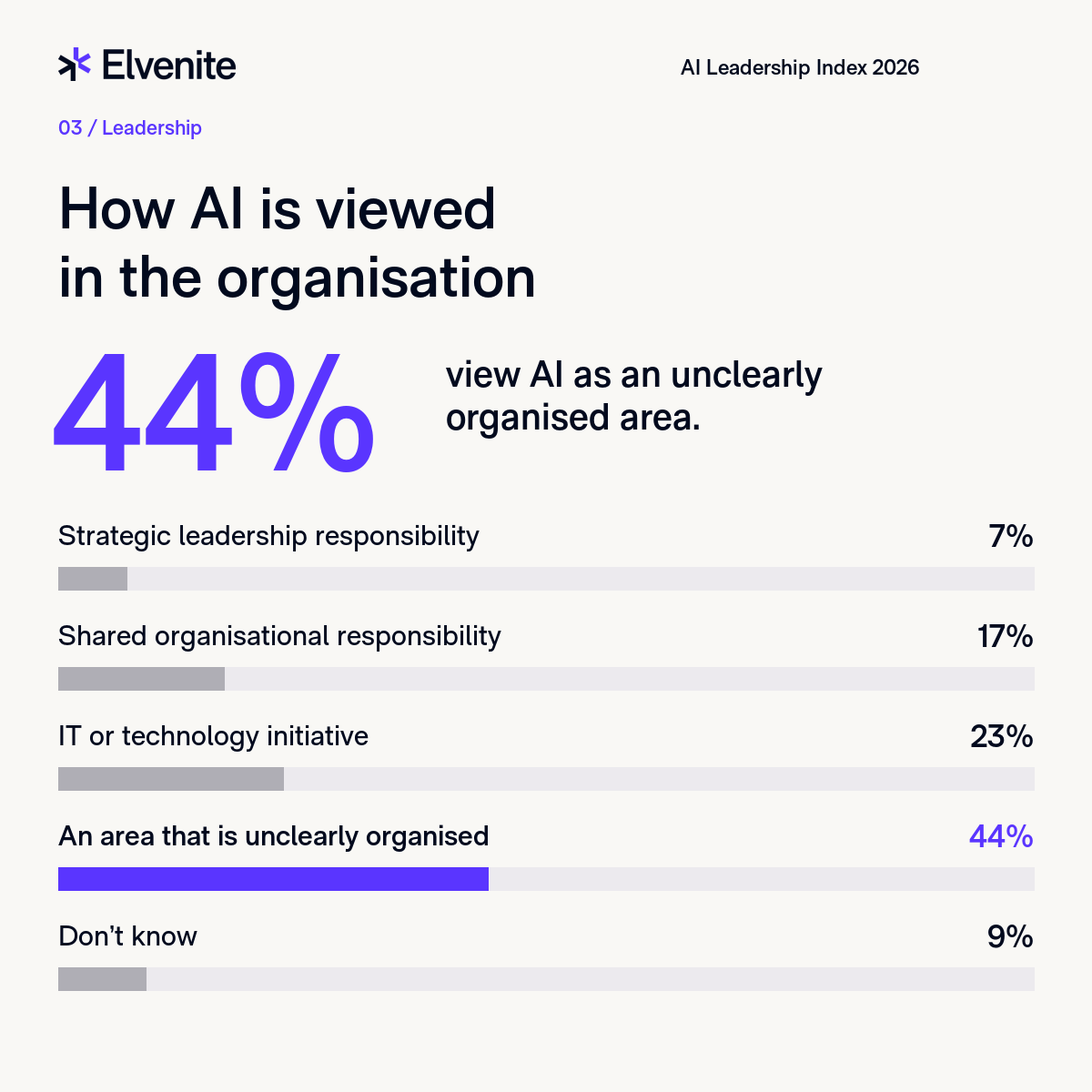
In Elvenite’s AI Leadership Index 2026, 42% say the board or executive management has formal responsibility for AI; 31% say management drives the work in practice. A separate question asks how AI is viewed: 44% describe it as an unclearly organised area, while 7% primarily see it as a strategic leadership responsibility.
AI Leadership Index 2026, leadership gap · Prime/Norstat · 163 respondents in Sweden · March–April 2026. Indicative; not statistically representative of Swedish business.
These are different survey questions. The figures do not show which individual organisations lack a mandate or establish what causes their difficulties. They give leaders a reason to examine whether formal responsibility includes the authority to act.
Who should own the AI initiative and its business result?
Name a business leader who can change the work the initiative is meant to improve. Define the intended result and the decisions delegated to that person. A technical lead remains responsible for technical delivery within their remit; the business owner is accountable for whether the new way of working is useful.
Hypothetical example
The commercial team wants AI support for preparing tender responses. Finance wants to improve account reconciliation. Both need the same data engineers. Each initiative has an executive sponsor, but neither sponsor can change the other team’s commitments.
For the tender initiative, the commercial leader could own the business result and decide how the bid team tests and uses AI-supported drafts. The mandate must also state what engineering capacity is committed and who approves it. A sponsor’s support alone does not make that capacity available.
Who decides when two AI initiatives need the same people?
The person or management forum authorised to balance both priorities must decide the allocation. In the example, management could sequence the tender and finance work, reduce their scopes or commit additional capacity. Each option should make clear what other work would be delayed.
Separate decisions within the initiative from decisions affecting other teams. The commercial leader may reorder tasks within the agreed allocation. Taking engineers away from finance requires approval from whoever controls that shared capacity.
Give unresolved conflicts a named decision-maker and a deadline. An existing management meeting is sufficient if it can make the choice. Record the allocation so both teams work from the same commitment.
What should management review and decide next?
Bring a specific choice, the evidence needed to make it and the consequence for other commitments. For the tender initiative, management might need to decide whether to extend the test and keep using engineering capacity that finance expects to receive next.
Compare preparation effort, specialist corrections and response quality with the current approach. State what remains uncertain. Management can then continue, change or stop the work, with an explicit decision on the capacity released or retained.
If the evidence is insufficient, specify what must be checked, who will check it and when the decision returns. Update the mandate after each change in scope, resources or authority.
Elvenite editorial recommendation
Test a one-page mandate against a real disagreement
For the hypothetical tender initiative, a completed mandate could read:
- Result and owner: The commercial leader owns a four-week test of whether AI-supported drafts reduce tender preparation effort while maintaining the quality of specialist-reviewed responses.
- Committed capacity: One data engineer for two days a week and one bid specialist for half a day a week during the test, agreed with their managers.
- Delegated decisions: The commercial leader selects test tenders and organises bid-team work within that allocation. Existing data-access and quality controls still apply.
- Management decisions: The executive team approves the initial sequence with finance. Additional capacity, a longer test or a delay to finance’s allocation requires its approval.
- Next decision and date: At the end of week four, before finance’s allocation begins, the executive team decides whether to stop, adapt or extend the test using the recorded effort, corrections and response quality.
The example, allocations and decision criteria are editorial suggestions, not survey findings or customer results. Replace them with agreed commitments in your business. If two sponsors disagree tomorrow, the page should make clear who decides and by when.
About the research
The AI Leadership Index 2026 survey was conducted by Prime for Elvenite through Norstat’s panel in March–April 2026. The 163 respondents in Sweden held responsibility for or strong insight into their organisation’s AI and digitalisation work. Findings are indicative and not statistically representative of Swedish business. The recommendations above are Elvenite’s editorial interpretation.

About the author
Elvenite
Elvenite is the Nordic market leader in Infor CloudSuite M3, data and AI. Our specialists share practical knowledge about ERP, Data Intelligence, AI and the long-term development of business-critical systems.
Learn more about Elvenite / Explore more articles from Elvenite
Related news



Explore the six AI leadership gaps