


The short answer
Practical AI governance gives people a way to recognise unreliable inputs, pause affected work, correct the cause and resume safely. For leaders responsible for operations, a policy becomes useful when these steps are clear enough to follow during an ordinary working day.
Three decisions to take away
- Make unreliable inputs and failed checks visible to users.
- Define when to pause, who repairs the cause and which fallback to use.
- Verify the correction and record approval before normal use resumes.
What the research found
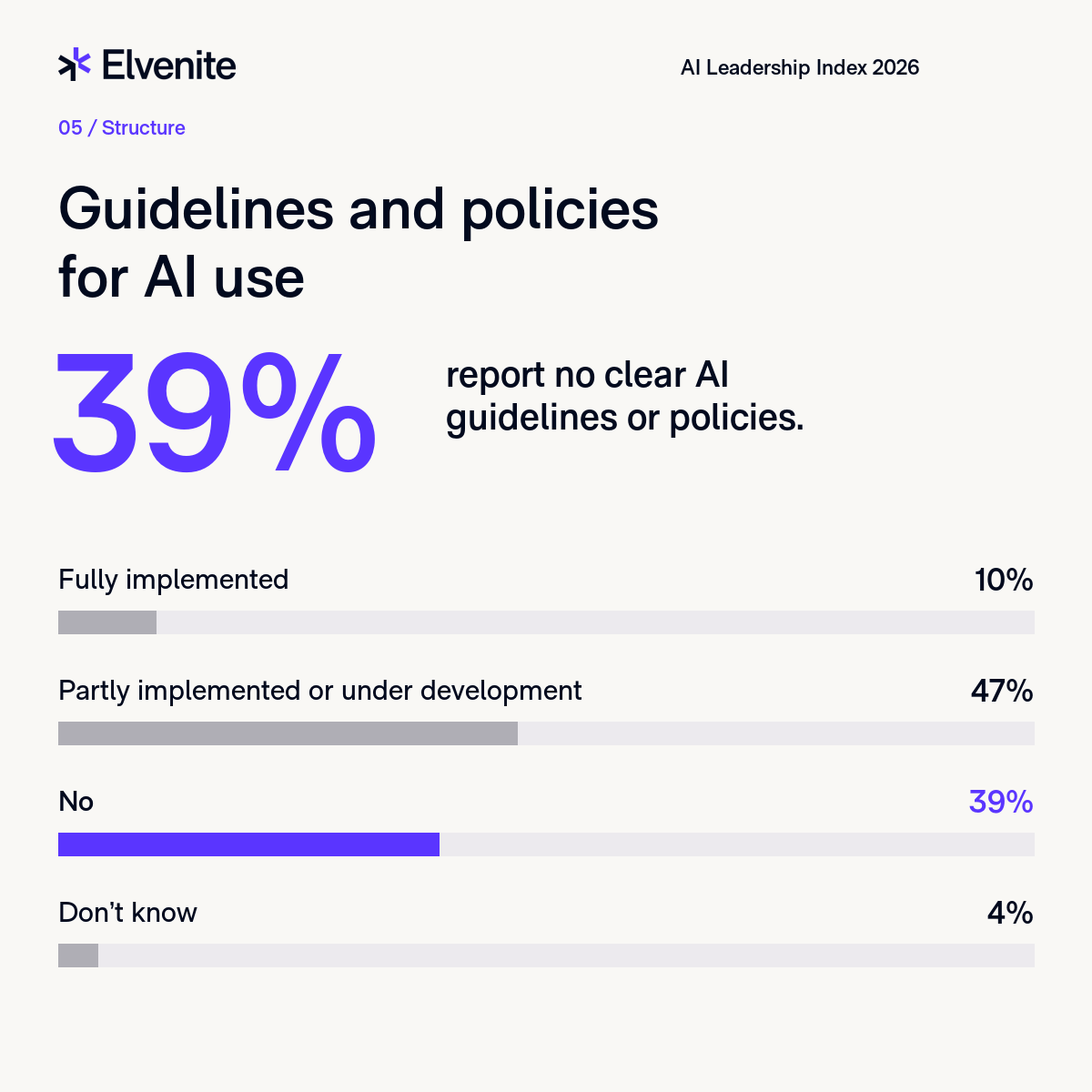
Elvenite’s AI Leadership Index 2026 identifies a structure gap. 39% say their organisation has no clear AI guidelines or policies, while 10% report fully implemented guidance. In separate questions, 57% report no process for following up on model performance, quality and risk, and 41% report no shared data environment for analysis, reporting or AI initiatives.
Prime for Elvenite, through Norstat’s panel · 163 respondents in Sweden · March–April 2026. Indicative; not statistically representative of Swedish business.
These findings describe different organisational conditions; they do not prove that introducing a policy or buying a platform will resolve them. The three decisions below are Elvenite’s editorial recommendations for operating controls, rather than a compliance assessment.
How will users recognise an unreliable AI result?
Check the source data as well as the output, and make failed checks visible where people use the result. Define the required freshness, completeness and coverage of inputs using limits appropriate to the planning cycle.
Hypothetical demand-forecast example
An overnight data connection fails, but the AI forecast still runs using the previous week’s demand file. The output looks plausible and carries a new generation date. A successful model run would not reveal that the underlying demand information is outdated.
Show when the source was last refreshed, which period it covers and whether required feeds passed validation. Keep those details close to the forecast. A new output timestamp must not imply that every input is current.
Compare the proposed production plan with current demand and investigate material changes. A planner should be able to identify the source behind a surprising recommendation.
What happens while the data is being corrected?
Pause the affected output, use an approved fallback and assign responsibility for repair and downstream review. In this example, a failed freshness check should prevent the forecast from entering the approved production plan.
Preserve the suspect output and its input details for investigation. Continue through the established manual planning process or another approved fallback using checked data.
Specify who receives the alert, who repairs the feed and who confirms the planning data is usable. A practical handover might connect the planner, the data owner and the team maintaining the integration.
Check how far the faulty result travelled. Correcting the source will not remove its effects in another system. Identify affected plans or actions and tell those responsible what needs review.
Document the source of record and how conflicting versions are resolved. The shared-data finding is a reason to examine these arrangements; it does not establish a mandatory platform migration.
What must be checked before normal use resumes?
Validate refreshed inputs, review replacement outputs and record who approved the restart. Check the expected dates, products and demand records. Rerun the forecast and compare it with current source information and the previous planning version.
Have the responsible planner review the result before it returns to the approved planning flow. Record what was corrected and which outputs were replaced. Keep the fallback available if the cause remains unresolved.
Review the incident afterwards. Was the check missing, was the alert overlooked, or did work continue despite a failure? Change the control that allowed the problem to pass. Repeat the check when a data source, integration or planning cycle changes.
Elvenite editorial recommendation
Take an operating checklist into the workflow
Test the checklist with the people running the process, using a deliberately outdated input in a safe test environment:
- Detect: Can users see source age, missing records and failed validations?
- Pause: Does a failed check stop the affected output reaching an approved plan?
- Correct: Is the repair route clear, including review of downstream effects?
- Restore: Are refreshed inputs, replacement outputs and restart approval recorded?
- Learn: Has the incident changed the check or working instruction that failed?
Start with the item your workflow cannot answer. Record the responsible person, the evidence needed and the next test date before expanding that use case.
These controls also matter as connected systems support selected actions through ERX, or Enterprise Resource Execution. Reliable inputs and a workable recovery path help control the consequences of those actions.
About the research
The AI Leadership Index 2026 survey was conducted by Prime for Elvenite through Norstat’s panel in March–April 2026. The 163 respondents in Sweden held responsibility for or strong insight into their organisation’s AI and digitalisation work. Findings are indicative and not statistically representative of Swedish business. The recommendations and forecast example are Elvenite’s editorial interpretation.

About the author
Elvenite
Elvenite is the Nordic market leader in Infor CloudSuite M3, data and AI. Our specialists share practical knowledge about ERP, Data Intelligence, AI and the long-term development of business-critical systems.
Learn more about Elvenite / Explore more articles from Elvenite
Related news




Explore the six AI leadership gaps