Data strategy: what it is, why it’s important and how to get started
3 minutes reading
A data strategy shows how you should collect, manage, analyse and use data so that it actually helps you achieve your business goals. It is your map from raw information to business benefit. At Elvenite, we help you create a clear roadmap with the initiatives and capabilities you need to become data-driven, and we also have the expertise to realise it. Our experts in data management, analysis and system integration lead and execute the projects that make the strategy a reality.

How we help you create a data strategy
A data strategy should not exist in a vacuum. It must be clearly linked to the business strategy. Our experience is that the more data-driven organizations become, the easier and more efficient they can achieve their goals.
To succeed, we need to understand both visions and challenges. Therefore, we work from a framework that combines interviews, workshops, and a structured process. The result is a roadmap that shows the way to real change.
Our method for creating a modern data strategy:
- Data strategy assessment – a current state analysis where we assess data maturity, strengths, and gaps.
- Data strategy workshop – interactive sessions where we, together with management and key personnel, identify and prioritise use cases that provide the greatest business value.
- Roadmap & implementation – we develop a concrete roadmap and ensure it becomes a reality.
Data strategy assessment
We start with a data strategy assessment, a current state analysis where we map data maturity, strengths and gaps. Here we also identify organisational barriers, knowledge gaps and technical prerequisites. It provides a clear picture of where the organisation stands and what steps are needed going forward.
Data strategy workshop
After the current state analysis, we lead data strategy workshops with management and the business. Here we capture both visions and practical needs and translate them into strategic directions.
Example: If a priority goal is to improve production planning in relation to sales, a direction could be "Balance supply and demand".
The strategic directions then serve as signposts. All initiatives and priorities we propose are mapped against these directions, ensuring that the data strategy drives towards business goals.
Roadmap & implementation
In the final step, we translate the directions into a concrete roadmap. It describes which initiatives should be implemented, in what order and with which dependencies.
The roadmap becomes a practical plan to achieve business goals. We also stay involved in the implementation – from establishing platforms and governance to integrating data sources and building new ways of working so that the strategy truly leads to results.
From strategy to implementation
Creating a data strategy is just the beginning, the value comes only when it is put into practice. That’s why we operate as both data strategy consultants and long-term data strategy partners.
In the implementation, we help with:
- Anchoring the strategic directions in the organisation.
- Building governance, processes, and roles.
- Implementing platforms and integrating data sources.
- Training and developing a data-driven culture.
In this way, the data strategy becomes not a document that collects dust, but a living part of business development.
What data foundation is needed before analytics, automation and AI can scale?
Direct answer: A scalable data foundation connects a clear business outcome to trusted source data, shared definitions, business ownership, quality rules, controlled access, reusable integration and ongoing monitoring. Automation and AI add further requirements: explicit process rules, exception handling, human review and clear responsibility for what happens when the output is wrong.
The foundation should become stronger as data moves closer to operational action. A reporting use case may tolerate a delayed refresh. An automated workflow needs reliable rules and exception handling. An AI agent that prepares or performs work also needs permissioned context, review boundaries and monitoring.
| Area | Analytics | Automation | AI assistants and agents |
|---|---|---|---|
| Primary task | Explain performance and support decisions. | Execute repeatable rules or move a workflow forward. | Gather context, prepare recommendations or perform approved workflow steps. |
| Minimum data foundation | Agreed definitions, traceable sources, suitable refresh cadence and quality checks. | Validated source data, process rules, exception handling and an operational owner. | Permissioned context, clear tool access, human-review boundaries, monitoring and an accountable workflow owner. |
| Main failure risk | Conflicting or misleading analysis. | Incorrect actions at greater speed. | Plausible output based on incomplete context, or action beyond the intended boundary. |
| Operating requirement | Data owner and quality monitoring. | Process owner, support routine and recovery path. | Data, system, risk and review ownership across the full workflow. |
Six things the data strategy must make explicit
- Business outcome and workflow: Define which decision, process or customer outcome should improve and who owns it.
- Data dependencies and source of truth: Map the systems, documents, fields and business rules the workflow depends on, including how conflicts are resolved.
- Ownership and quality: Assign business responsibility for definitions, completeness, accuracy, timeliness and acceptable use.
- Access and governance: Decide who or what may read, combine, recommend or update data, based on role, purpose and risk.
- Reusable integration and platform: Make important data available through maintained pipelines, APIs or data products instead of rebuilding one-off inputs for each use case.
- Review and monitoring: Define approval points, exceptions, output checks, error handling and how the workflow will improve after launch.
This is where data strategy becomes practical. It connects management priorities and platform choices to the conditions required for a report, automation or AI-enabled workflow to be trusted in daily operations. These decisions can then feed into a broader Data Intelligence roadmap.
For a deeper ownership checklist, read The real AI bottleneck is data ownership, not model choice.
For companies working with operational ERP data, the integration layer also matters. The article on integrating Infor CloudSuite M3 data with Microsoft Fabric, Azure and AWS shows how M3 data can be made available to a modern data platform. The strategy still needs to decide which data is worth connecting and which business need it should serve.
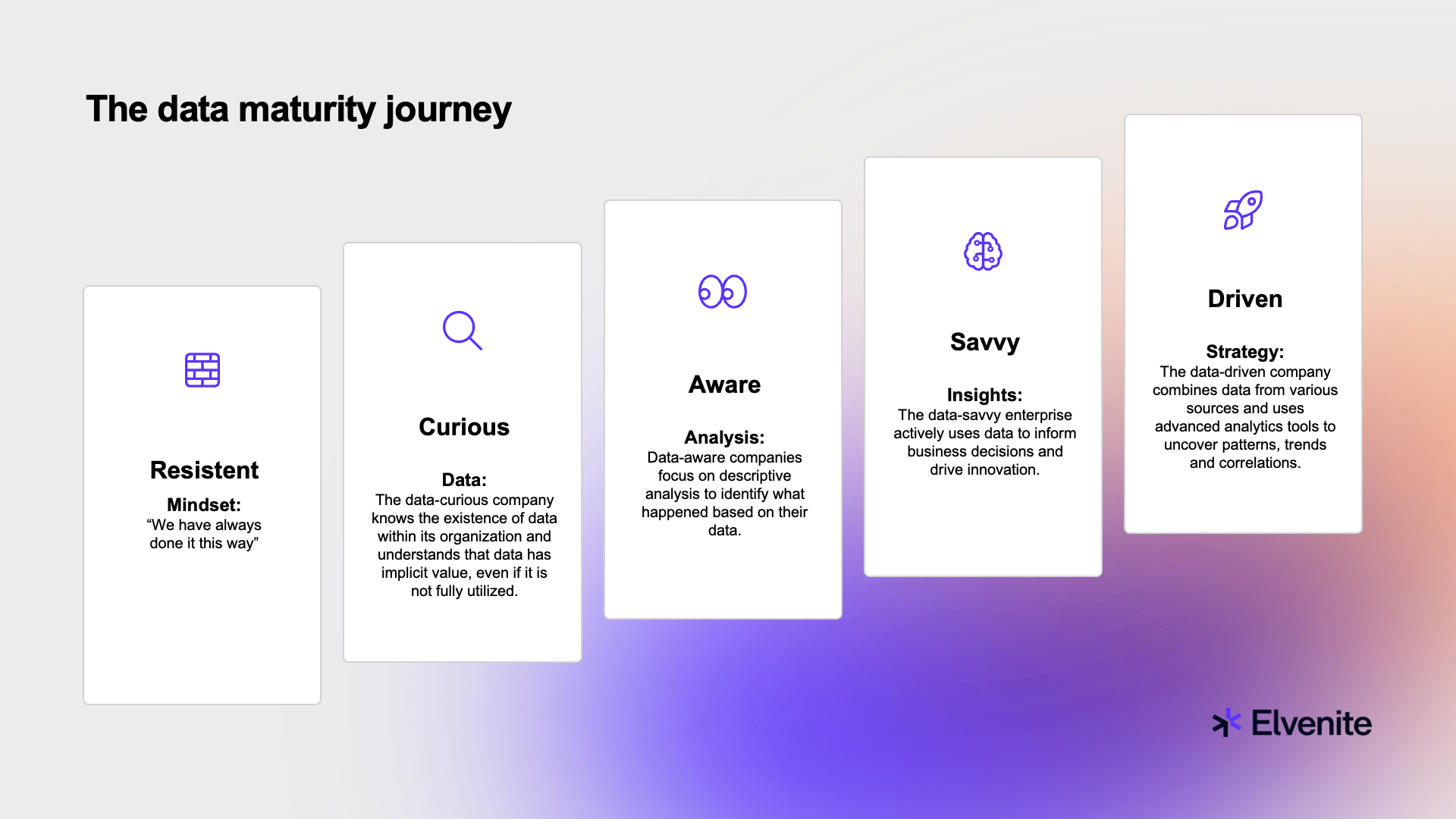
Where is your company on the path to becoming data-driven? With our model, we identify the current situation, set the direction, and help you take the step towards a business where data drives decisions.
Examples of successful data strategy projects
We have worked with organisations at very different stages of their data journey – from those that are already underway to those that are starting from scratch. One practical example is how Skellefteå Kraft made fragmented operational data useful in daily work through better structure, transparency and control over inventory flows.
The coffee company
The company already had some (data) BI usage in the form of reports and dashboards, but lacked a clear overall picture. Data was scattered, KPIs (and business logic) were defined in different ways in different parts of the organisation, and much of the analysis was still done manually in Excel.
With the help of a data strategy, they were able to:
- Agree on common KPIs and definitions.
- Implement a modern analytics platform that made data more accessible and usable.
- Get a clear roadmap showing which initiatives should be prioritised to take the next step towards a data-driven culture.
The logistics company
As a newly formed company, they had no established ways of working with data. They lacked both structure, governance, and a plan for how data could support business goals. At the same time, the need was great, from following up on customer relationships to optimising logistics flows.
Here, we helped to:
- Build their very first data strategy from scratch.
- Identify which data sources were most important to start with.
- Create a framework for how they could grow incrementally and become more data-driven over time.
Regardless of whether the starting point is fragmented follow-up or a total lack of strategy, a clear data strategy makes the difference between groping in the dark and steering the organisation using data.
Frequently asked questions about data strategy
What is a data strategy?
A data strategy explains how your organisation will use data to support its goals. It sets priorities, assigns responsibility, defines quality standards and guides technology choices. The result is a shared plan that helps people trust the data they use and turn it into better decisions and measurable business value.
Why does my company need a data strategy?
Without a shared data strategy, teams often use different definitions, repeat the same work and invest in technology without a clear business purpose. A data strategy creates a common direction, helping your company improve decisions, work more efficiently and build data capabilities that remain useful as needs change.
When is the right time to start working on a data strategy?
Start when important decisions depend on data but teams do not share the same priorities, definitions or responsibilities. It is especially valuable before a major investment in analytics, automation, AI or a new data platform because it helps you focus on the right business needs from the beginning.
What are the key components of an effective data strategy?
An effective data strategy covers business goals, priority use cases, data ownership, shared definitions, quality, access, governance, technology, integration and skills. It should also include a practical roadmap that shows what to do first, who is responsible and how the company will measure progress and business value.
How do we get started with our data strategy?
Begin with the business decisions, processes or outcomes you want to improve. Review your current data, systems, responsibilities, quality and skills. Bring the relevant business and technology leaders together to agree on priorities, then create a step-by-step roadmap with clear owners, dependencies, measures and regular review points.
What data foundation is needed for AI and automation?
AI and automation need reliable data, shared definitions, clear ownership, quality checks, secure access and dependable connections between systems. You also need rules for how the data may be used, how exceptions are handled and when a person must review or approve an action. The safeguards should reflect the potential business impact.
Should analytics, automation and AI use separate data strategies?
Usually not. Analytics, automation and AI should follow the same overall data strategy and use the same approach to ownership, quality, access and technology. Individual projects may have different requirements, but separate strategies often duplicate work, create conflicting definitions and make data harder to govern across the organisation.
Create your own data strategy together with Elvenite
Related news

Swedish companies score only 39 out of 100 in new AI Leadership Index

Blentagruppen selects Elvenite for Infor CloudSuite Food & Beverage